Tuesday, 5 July 2011

Fan controller

INTRODUCTION
The project is a fan controller, it's a simple remote switch power via IR.
In my case I am going to use the switch power to turn on/off a wall fan with a remote controller of the television.


ITEM

  • Fez Domino ( it's similar as Arduino but you code it in C# )
  • IR Receive Brakout
  • Relay 230V
  • Remote IR
  • Power BOX
DESCRIPTION
The project is using Fez Domino instead Arduino because I realized that this kind of platform it's too slowly and it good only for small project as this.
I figured out what is the code of a special button on the remote controller and I coded the Fez Domino to intercept it. When it intercept the IR code, it turns on or off ( status = ! actual status ) the Relay.

POWER
I recycled  a old Nokia power supply and it consume only 1.5 Watt.


VIDEO TEST


Monday, 13 June 2011

Progress

Dopo una lunga attesa ho convertito maggior parte del mio codice per Arduino.
I componenti sono funzionati subito al volo, non come per Fez Domino dove ho dovuto tribulare, ora l'unico intoppo è la camera che mi ritorna 1/4 dell'immagine.

Ho testato il modem gprs e sono riuscito a far muovere il servo da remoto, finalmente!


Monday, 30 May 2011

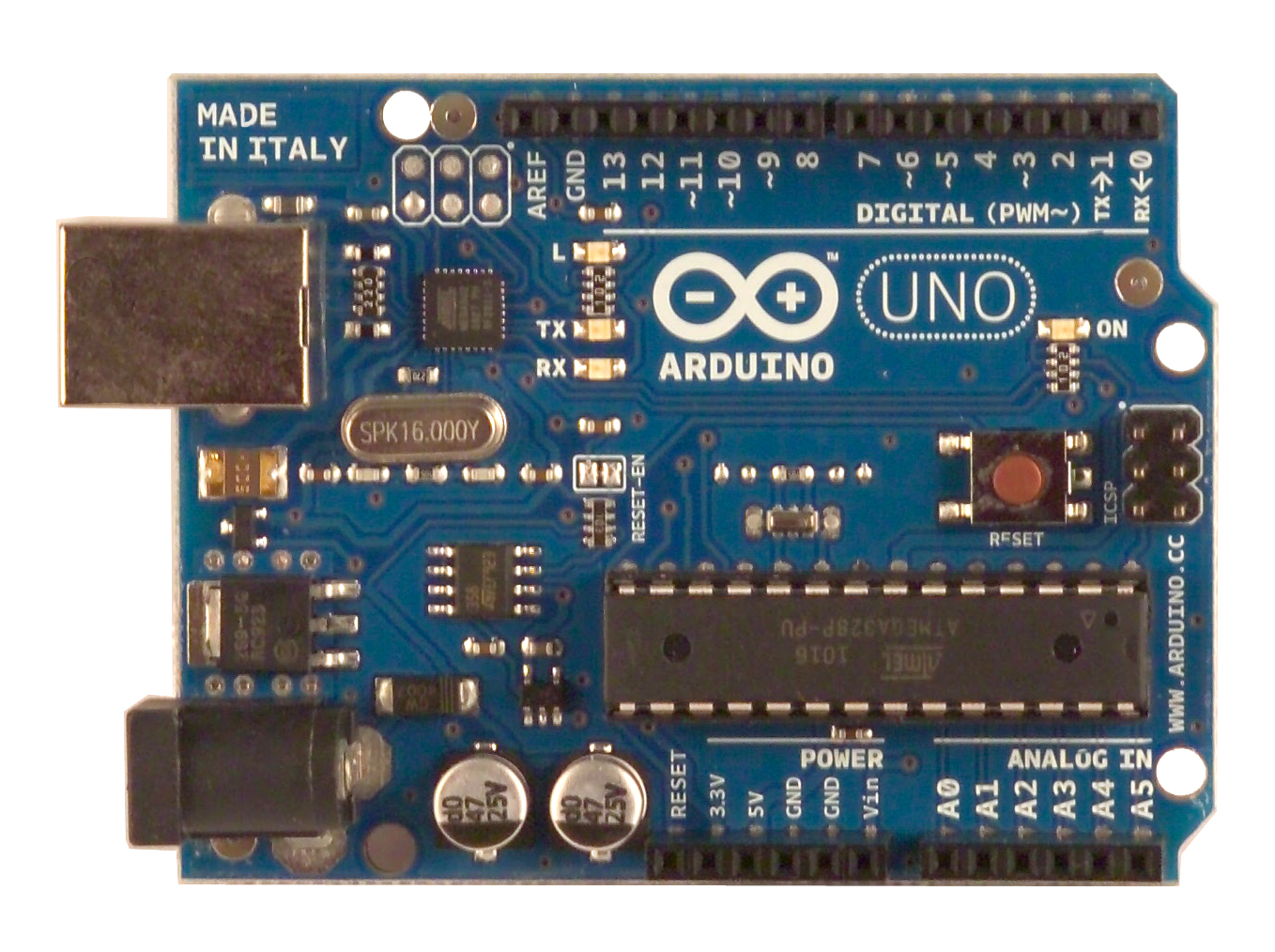
Arduino Uno

Overview

The Arduino Uno is a microcontroller board based on the ATmega328 (datasheet). It has 14 digital input/output pins (of which 6 can be used as PWM outputs), 6 analog inputs, a 16 MHz crystal oscillator, a USB connection, a power jack, an ICSP header, and a reset button. It contains everything needed to support the microcontroller; simply connect it to a computer with a USB cable or power it with a AC-to-DC adapter or battery to get started.
The Uno differs from all preceding boards in that it does not use the FTDI USB-to-serial driver chip. Instead, it features the Atmega8U2 programmed as a USB-to-serial converter.
"Uno" means one in Italian and is named to mark the upcoming release of Arduino 1.0. The Uno and version 1.0 will be the reference versions of Arduino, moving forward. The Uno is the latest in a series of USB Arduino boards, and the reference model for the Arduino platform; for a comparison with previous versions, see the index of Arduino boards.

Summary

MicrocontrollerATmega328
Operating Voltage5V
Input Voltage (recommended)7-12V
Input Voltage (limits)6-20V
Digital I/O Pins14 (of which 6 provide PWM output)
Analog Input Pins6
DC Current per I/O Pin40 mA
DC Current for 3.3V Pin50 mA
Flash Memory32 KB (ATmega328) of which 0.5 KB used by bootloader
SRAM2 KB (ATmega328)
EEPROM1 KB (ATmega328)
Clock Speed16 MHz

Problems and solutions

Ho constatato che il Fez domino non è adatto per questo genere di progetto, allora ho iniziato a comprare il mio nuovo controller, Arduino UNO.
Con l'Arduino ho un supporto migliore ed è più facile sviluppare a livello hardware, il Fez domino non è ancora pronto per questo genere di cose.

Come si puo trovare su internet, si puo prendere spunto su da questo progetto http://jayeshprojects.blogspot.com/2010/04/real-time-mobile-gps-tracker-with.html o vi sono librerie per aiutarti nello sviluppo.

Ora mi dedico alla riscrittura del codice per l'arduino.

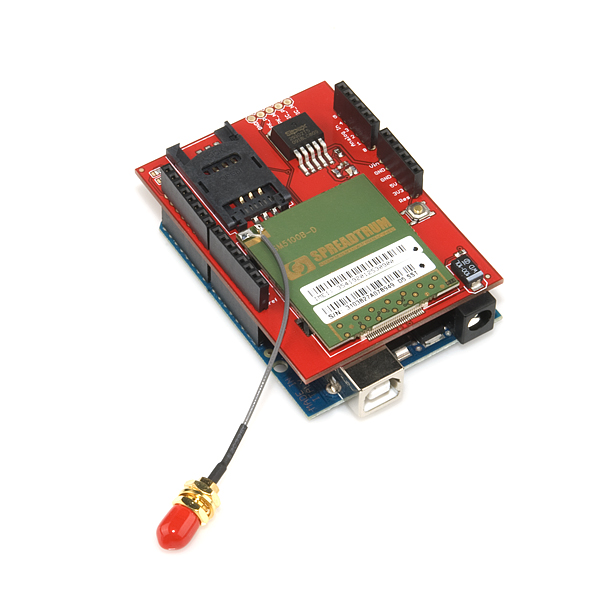
Cellular Shield with SM5100B


Description: The Cellular Shield for Arduino includes all the parts needed to interface your Arduino with an SM5100B cellular module. This allows you to easily add SMS, GSM/GPRS, and TCP/IP functionalities to your Arduino-based project. All you need to add cellular functionality to your Arduino project is a SIM card (pre-paid or straight from your phone) and an antenna and you can start sending Serial.print statements to make calls, send texts and serve web pages!
 The main components of the Cellular Shield are a 60-pin SM5100B connector, a SIM card socket, and an SPX29302 voltage regulator configured to regulate the Arduino's raw voltage to 3.8V. The board's red LED indicates power. The Arduino's reset button is also brought out on the shield.

Two solder jumpers on the board allow you to select which serial pins interface with the cellular module - software (D2, D3) or hardware (D0, D1). There is also a 5-pin, 0.1" spaced header with connections for microphone inputs and speaker outputs. Headers are not soldered on, we recommend the 6 and 8-pin stackable headers.

The SM5100B cellular module is included with this product, however an antenna is not. It is pre-configured to 9600bps.

Friday, 13 May 2011

Relay Module 5V RLY101-FR4


1 PCS One channel relay module board, for PIC / AVR / 8051 etc project.
Led indicator for each relay channel.
Use BC547  driving relay, Improve the reliability of action.
Power Supply: 5V / 400mA.
Input voltage: 0V - 0.5V (relay is OFF),
                         0.5V - 4V (unknown state),
                         4V - 5V (relay is ON).
PCB thickness: 1.6mm.

Relay Spec:
Coil: Voltage: 5V DC.    Current: 71.4mA.
Contact Capacity: 250 VAC/7 Amp or 30 VDC/10 Amp.

Sunday, 8 May 2011

SIMCOM SIM300 GPRS+GSM Module Mini Board AVR Arduino


General features


  • Tri-Band GSM/GPRS 900/1800/1900MHz or Quad-Band GSM.GPRS 850/900/1800/1900MHz

  • GPRS multi-slot class 10/8

  • GPRS mobile station class B

  • Compliant to GSM phase 2/2+
           Class 4 (2W @ 900MHz)
           Class 1 (1W @1800/1900MHz)

  • Dimensions: 50mmx33mmx6.2mm

  • Weight: 13.8g

  • Control via AT commands (GSM 07.07, 07.05 and SIMCom enhanced AT Commands)

  • SIM application toolkit

  • Supply voltage range 3.4V - 4.5V

  • Low power consumption

  • Normal operation temperature:
          -30°C to +70°C

  • Restricted operation temperature:
          -35°C to +80°C

  • Storage temperature:
          -40°C to +85°C


  • More information: http://projectsmax246.blogspot.com/2011/04/socket-and-gprs.html